How to Choose Emergency Vehicles for Remote and Off-Road Areas
Emergency response in remote areas is not only about arriving fast. The vehicle must first reach the site, carry the right resources, support field work, and keep operating when roads, fuel supply, and infrastructure are limited.
In cities, emergency vehicles usually work on paved roads with nearby fuel stations, water sources, repair teams, and service facilities. In mining areas, forests, rural communities, construction zones, deserts, and flood-affected regions, conditions are different. Roads may be muddy, sandy, steep, damaged, or unfinished. A standard urban vehicle may not have enough traction, ground clearance, tank capacity, or functional equipment for the job.
That is why remote emergency response should be planned as a vehicle system, not as one single truck. A practical fleet may need a fire truck, a fuel supply truck, a utility repair vehicle, and sanitation support equipment.
This guide explains how to choose emergency and support vehicles for remote and off-road areas, with selected Isuzu vehicle examples from Prosper Motors.
Start with the Mission, Not the Vehicle Type
Before selecting a model, define what the vehicle must do in the field. Remote emergency response usually includes four types of work:
Field Need | Vehicle Role | Why It Matters |
|---|---|---|
Reach the emergency site | Off-road fire truck or 4x4 support vehicle | Mud, sand, gravel, slopes, and flooded roads can block standard vehicles |
Bring critical resources | Fuel truck or water tank fire truck | Remote areas may lack nearby fuel or water supply |
Repair damaged infrastructure | Auger digger truck or aerial work vehicle | Power, telecom, and lighting systems may need urgent repair |
Restore basic services | Sanitation and waste collection truck | Waste buildup after disasters or in remote communities can create secondary problems |
This structure keeps the selection process practical. The buyer is not simply choosing “a fire truck” or “a fuel truck.” The buyer is building an emergency response fleet around real operating conditions.
Road Conditions Decide the Drive Layout
Drive type is one of the first specifications to check for remote operations.
For paved roads and city response, a 4x2 vehicle may be enough. For remote areas, 4x4 or 6x6 mobility becomes more important. A 4x4 vehicle helps when the route includes unpaved roads, mud, sand, gravel, or construction access roads. A 6x6 vehicle provides stronger traction and load support when the vehicle carries a heavy body, large water tank, or firefighting equipment.
Ground clearance, tire configuration, suspension, axle load, and vehicle weight also matter. A truck with the right tank or body can still fail the job if it cannot reach the site safely.
1. Isuzu 6x6 Fire Truck: Reaching Fire Scenes Beyond Paved Roads
For remote firefighting, water capacity alone is not enough. A fire truck must carry water and firefighting equipment into locations where standard road vehicles may struggle.
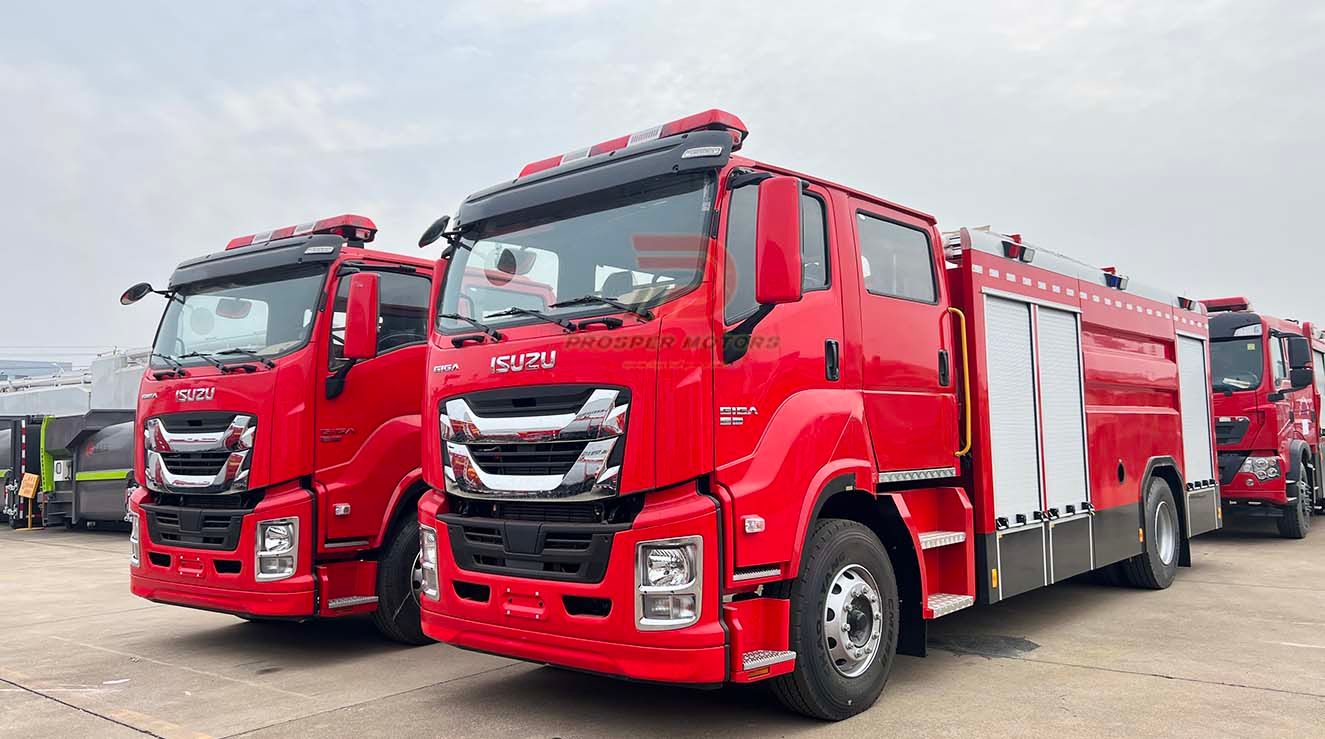
The ISUZU GIGA CYZ77P 6x6 15000L RHD Water Tank Fire Truck is designed for demanding firefighting operations and challenging terrain. It uses a 6x6 all-wheel-drive layout, a 15,000-liter water tank, and a 460HP Isuzu 6WG1 engine. The RHD cabin also makes it suitable for left-hand traffic markets.

Key Specifications
Key Specification | Details |
|---|---|
Model | GIGA CYZ77P |
Drive Type | 6X6 |
GVW(kg) | 35,000 |
Power(PS/Rpm) | 460 @1200 |
Engine Model | 6WG1 |
Water tank volume | 15,000 liters |
Fire pump | CB10/60 |
Fire monitor | PL48 |
Pump flux | 3600L/M |
The 6x6 layout helps the vehicle operate on mud, sand, gravel, flooded roads, and steep terrain. The 15,000-liter water tank supports longer fire suppression work where external water sources may not be close to the fire scene.
This model is suitable for mining areas, forests, remote communities, industrial zones, and off-road emergency routes.
Product: ISUZU GIGA CYZ77P 6x6 15000L RHD Water Tank Fire Truck
2. Isuzu NPS Fuel Truck: Keeping Remote Operations Supplied
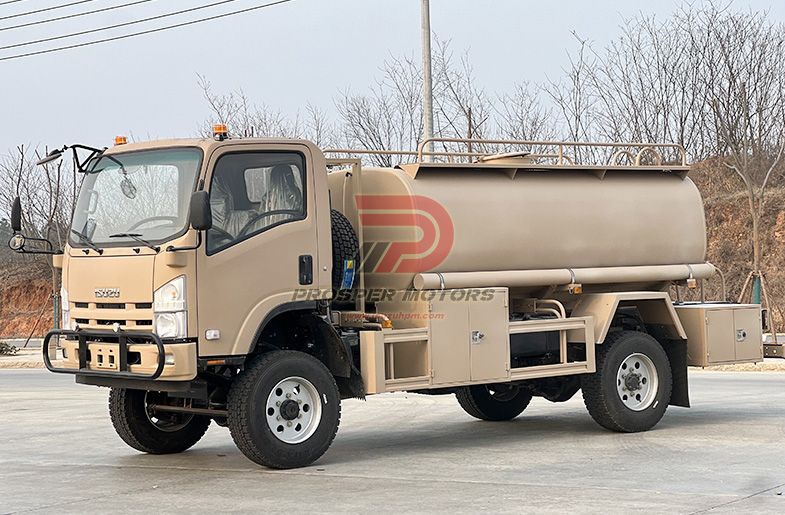
Fuel supply is a major constraint in remote emergency work. Fire trucks, generators, construction machines, repair vehicles, and field support equipment all need reliable refueling. If the fuel truck cannot reach the site, other emergency vehicles may stop working.
The ISUZU 4X4 NPS 8000L Fuel Truck is built for demanding environments such as deserts, mining sites, and remote military operations. It uses an Isuzu NPS all-wheel-drive chassis, 8m³ fuel tank capacity, 190HP engine, reinforced suspension, differential lock, high-ground-clearance design, and 600mm water fording depth.
Key Specifications
Key Specification | Details |
|---|---|
Model | NPS |
GVW(kg) | 12,000 |
Power(PS/Rpm) | 190hp |
Loading Capacity(m³) | 8 |
Engine Model | 4HK1-TCG61 |
Transmission | Manual 6 Forward & 1 reverse |
Tire Size | 825R20 |
Pump System | 300L/min discharge rate |
This model is suitable for remote mining and oilfield fuel supply, rural emergency refueling, military support, forestry operations, and construction projects where ordinary fuel delivery vehicles may face access problems.
Product: ISUZU 4X4 NPS 8000L Fuel Truck
3. Isuzu FTS 4x4 Boom Truck with Auger Digger: Repairing Utility Infrastructure
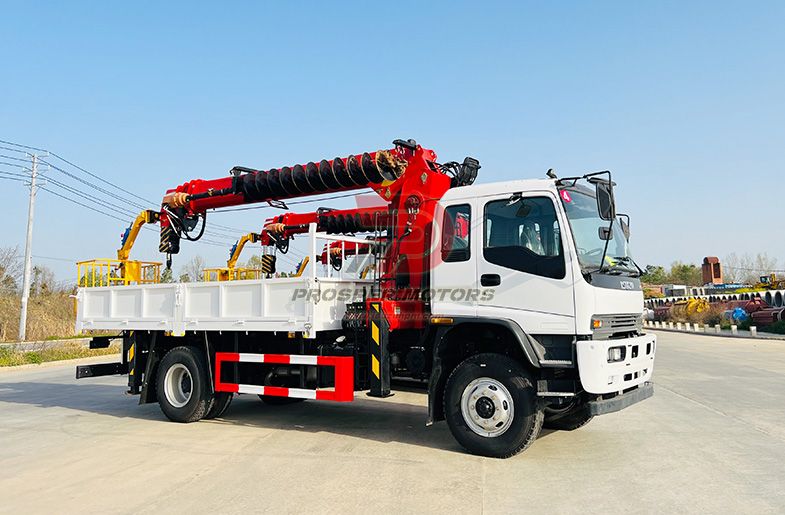
Remote emergencies often damage more than roads. Power lines, telecom poles, streetlights, and utility foundations may also need urgent repair. In these situations, a utility repair truck can be as important as a fire truck or fuel truck.
The ISUZU FTS 4X4 Boom Truck with Auger Digger combines transport, drilling, lifting, and aerial work in one vehicle. It is designed for construction, utility maintenance, and industrial projects where crews need to drill, lift, and work at height.
Key Specifications
Key Specification | Details |
|---|---|
Model | FTS |
Drive Type | 4X4 |
GVW (Kg) | 18,000 |
Power(PS/Rpm) | 205 @2600 |
Max. lifting Weight(T) | 10 |
Engine Model | 4HK1 |
Wheelbase | 4,700mm |
Tire Size | 11.00R20 |
The vehicle supports hydraulic auger drilling for soil piles, rotary drilling for harder ground, and a 200kg work basket for aerial work. It can help crews drill pole foundations, lift materials, and support workers during power line repair, streetlight installation, telecom maintenance, solar panel mounting, and remote construction support.
Product: ISUZU FTS 4X4 Boom Truck with Auger Digger
4. Isuzu NPS 4x4 Compressed Garbage Truck: Restoring Sanitation After Emergency Events
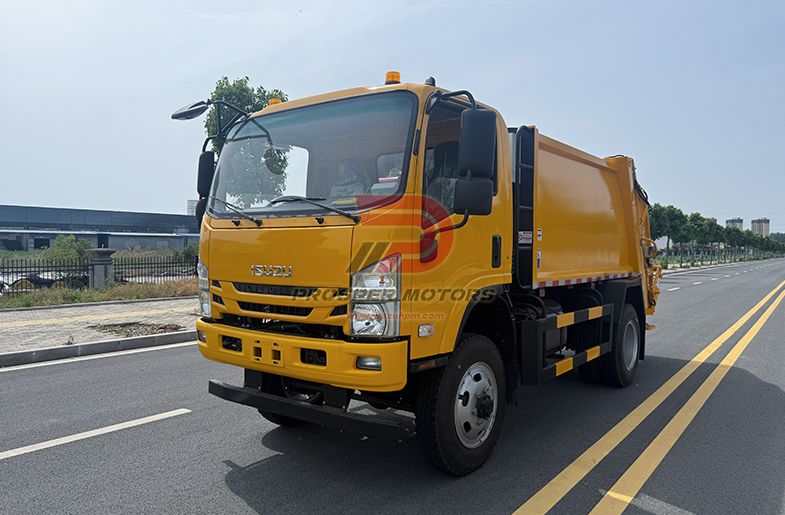
Emergency response does not end when the fire is controlled or the road is reopened. Remote communities, industrial sites, and disaster-affected areas also need waste collection and sanitation support. Without proper waste handling, temporary camps, damaged communities, or isolated work sites can face hygiene and environmental problems.
The ISUZU NPS 4X4 Compressed Garbage Truck is designed for challenging routes, remote areas, and uneven terrain where standard refuse vehicles may not operate effectively. It uses an NPS 4x4 chassis, 190HP engine, 10,550kg GVW, and 8cbm garbage tank capacity.
Key Specifications
Key Specification | Details |
|---|---|
Model | NPS |
Drive type | 4x4 |
GVW (Kg) | 10,550 |
Engine Model | 4HK1-TCG61 |
Engine HP | 190HP |
Garbage tank Capacity | 8cbm |
Transmission | Manual 6 Forward & 1 reverse |
Tire Size | 825R20 |
This model is suitable for remote communities, industrial complexes, suburban areas, temporary project sites, and difficult waste collection routes where both 4x4 mobility and waste compaction are required.
Product: ISUZU NPS 4X4 Compressed Garbage Truck
Key Questions Before Choosing Remote Emergency Vehicles
When planning an emergency fleet for remote or off-road areas, focus on the operating mission first.
Important questions include:
What road conditions will the vehicle face? Mud, sand, gravel, slopes, flooded roads, and unpaved routes may require 4x4 or 6x6 mobility.
What must the vehicle carry? Fire water, fuel, tools, drilling equipment, waste, or rescue materials all require different body structures.
How far is the site from supply points? Longer distance increases the importance of tank capacity, payload, and fuel autonomy.
Will the vehicle work after arrival? Some vehicles only transport resources; others must pump, drill, lift, compact, or support aerial work.
Does the vehicle need to match local traffic rules? Export markets may require left-hand-drive or right-hand-drive configuration.
Final Thoughts
Choosing emergency vehicles for remote and off-road areas is not about buying the largest truck. It is about matching the vehicle to the route, mission, and available support network.
A 6x6 fire truck helps reach difficult fire scenes with large water capacity. A 4x4 fuel truck keeps remote emergency equipment supplied. A 4x4 auger digger truck supports power, telecom, and utility repair. A 4x4 compressed garbage truck helps restore sanitation services after emergency events or in isolated communities.
For remote operations, the right fleet must do four things: reach the site, bring critical resources, repair damaged infrastructure, and restore basic services.
Prosper Motors provides Isuzu special-purpose vehicles for firefighting, fuel supply, utility repair, sanitation support, and off-road operations. Share your road conditions, emergency task, required capacity, and destination country, and the team can recommend a suitable vehicle configuration for your project.
Website: www.isuzuhpm.com